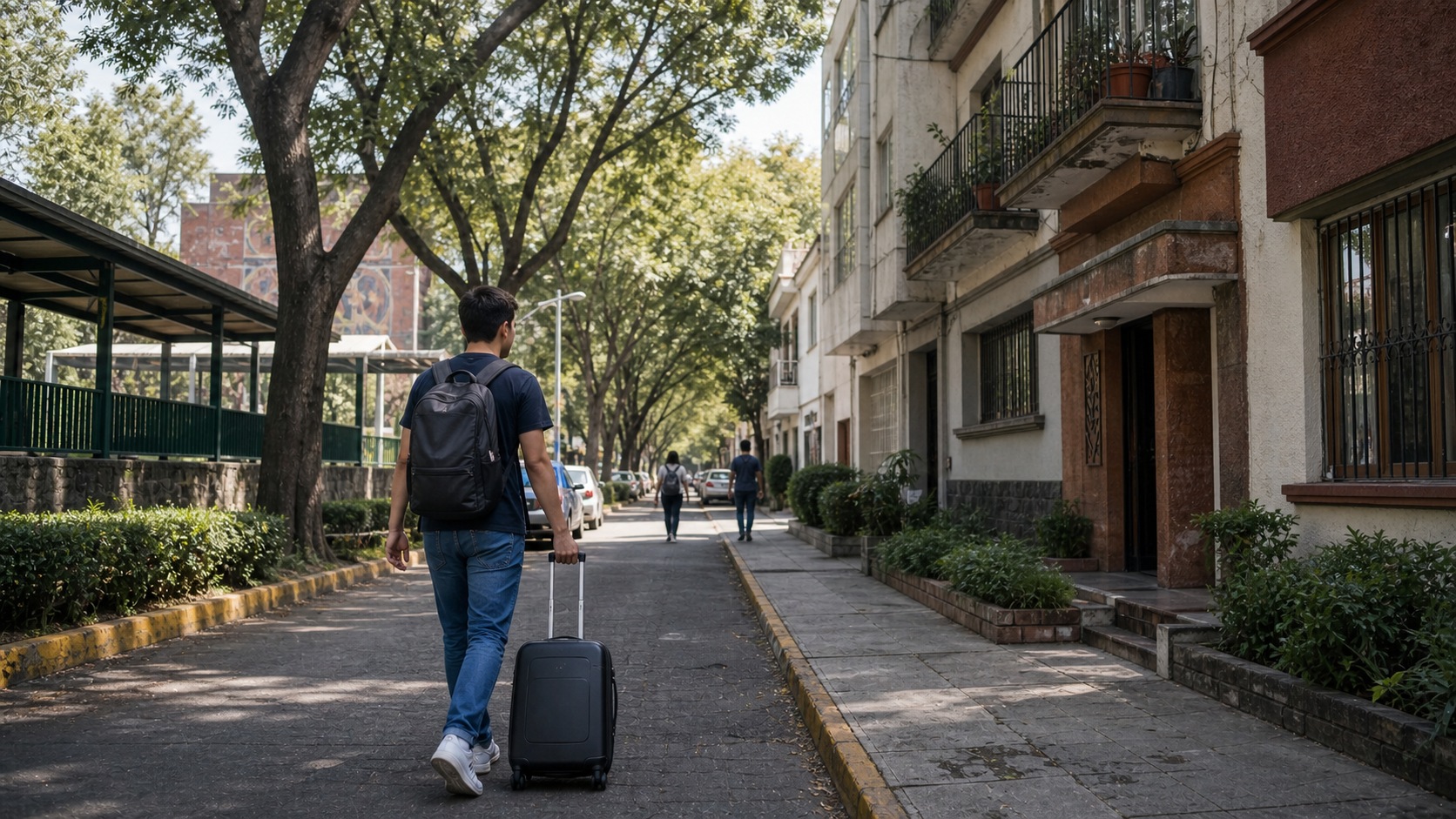
We’ve lived in Roma Norte for over four years. Between us and our 299+ Airbnb guests, we’ve taken hundreds of rides on Uber and Didi across Mexico City: airport runs, 2 AM returns, rainstorms, grocery trips, hospital corridors, and the tiny rides where a driver clearly wishes you had just walked.
Here is what we tell guests now, updated June 2, 2026: download both apps before you land. Open Didi first when price matters. Open Uber first when timing, product options, or late-night availability matter.
Do the app setup before the flight, not at the airport curb. If you still need mobile data planning, use our Mexico City SIM card guide for digital nomads before you rely on either app.
If you are choosing a base for a longer work stay, transport is only one part of the decision. Pair this guide with our overview of digital nomad apartments in CDMX so your commute, cafe access, and at-home workspace fit the same routine.
The short answer, updated June 2026
Didi often wins on price. Uber usually wins on product depth and backup reliability.
That sounds like a neat sentence. Real life is messier.
For a normal daytime ride in Roma Norte, Condesa, Juarez, Narvarte, or Polanco, Didi is often the first app worth checking. For late-night rides, work meetings, AICM uncertainty, or anything where a cancellation creates stress, Uber is usually the better backup. In 2026, Uber also has more Mexico-specific features to pay attention to: Uber Mujeres launched in Mexico in May 2026, Uber Shuttle is active on some routes, and Uber has been preparing airport and World Cup mobility products.
The app may work. The curb is the problem.
Real Uber receipt examples from CDMX
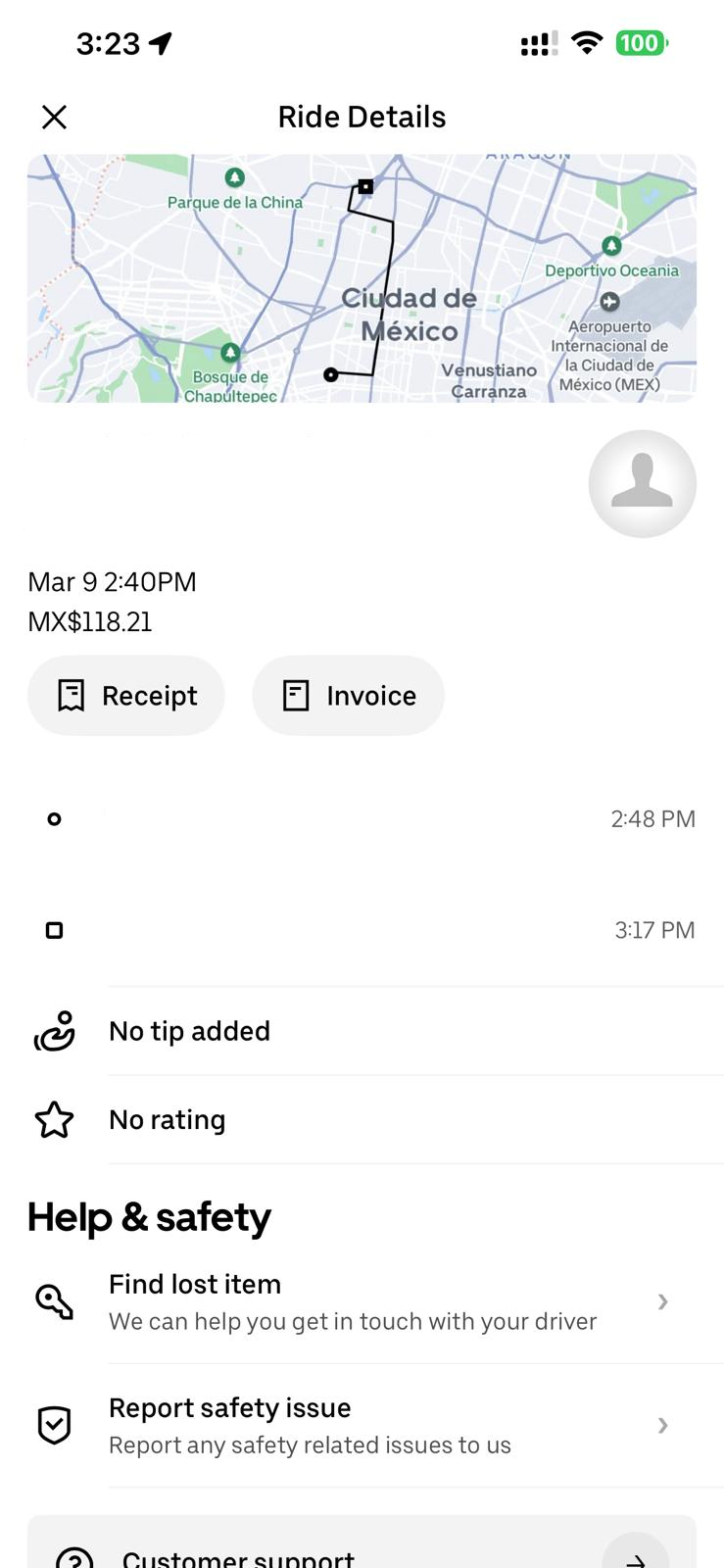
The two screenshots below are real Uber Wait & Save rides from March 2026. They are not live fare guarantees. They are proof of the kind of app fare we actually see around Mexico City when a ride is not in heavy surge.
We removed driver names and exact street addresses. The receipt fare, date, route map, timing, and app context remain visible.
StayWork ride proof
Two real receipt examples, mapped and measured
Distances are approximate mapped driving routes calculated from the receipt route context. App fares change with demand, weather, traffic, driver availability, and pickup rules.
Narvarte area to AICM Terminal 1
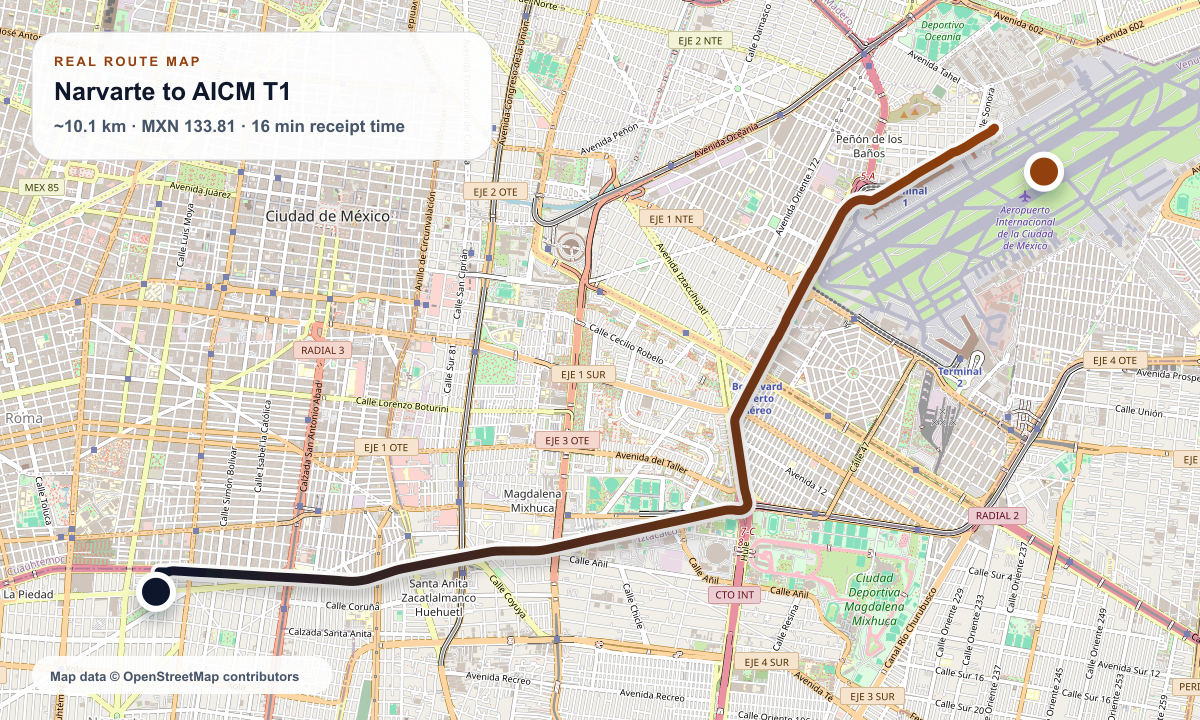
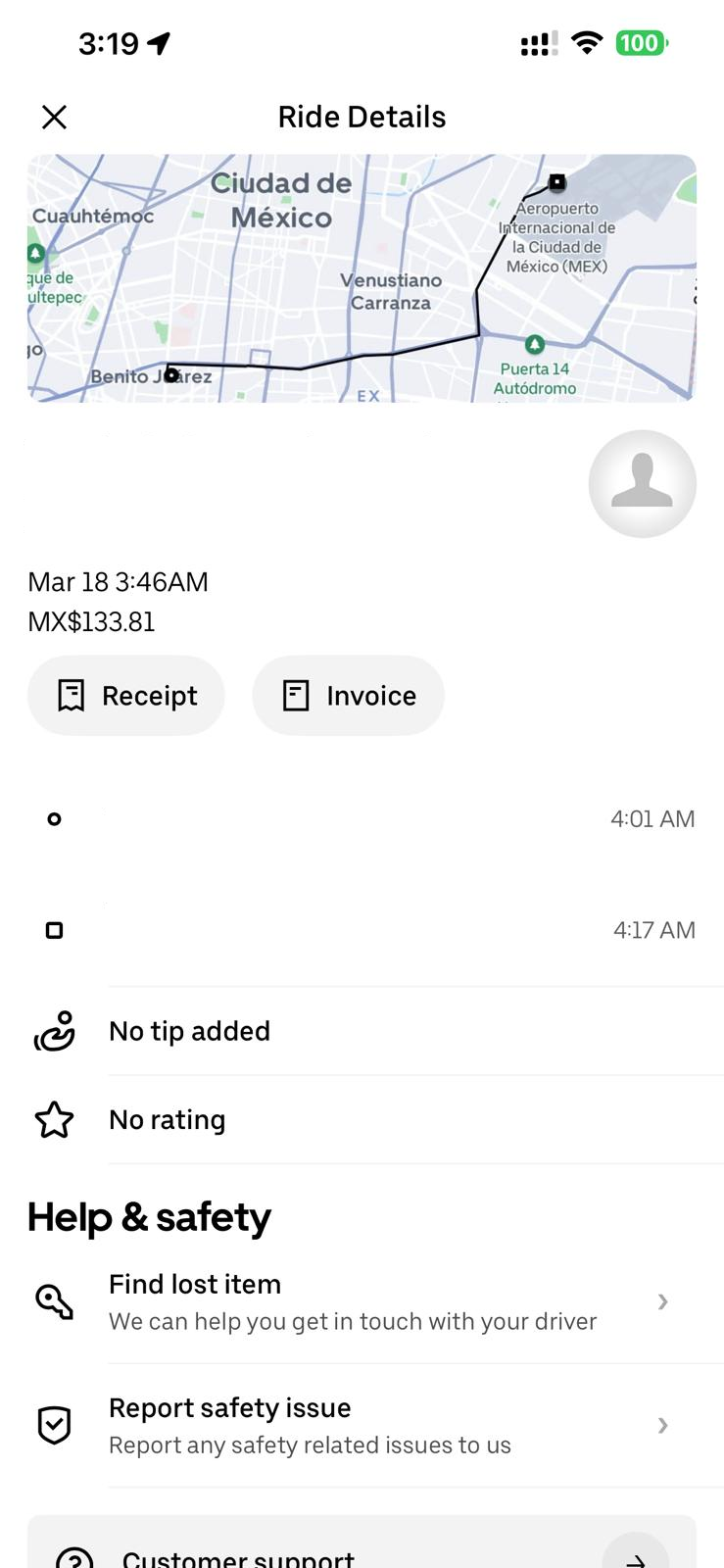
This is the kind of airport-departure fare that makes app rides attractive when pickup and timing are clear.
Cuauhtemoc to Santa Maria Insurgentes
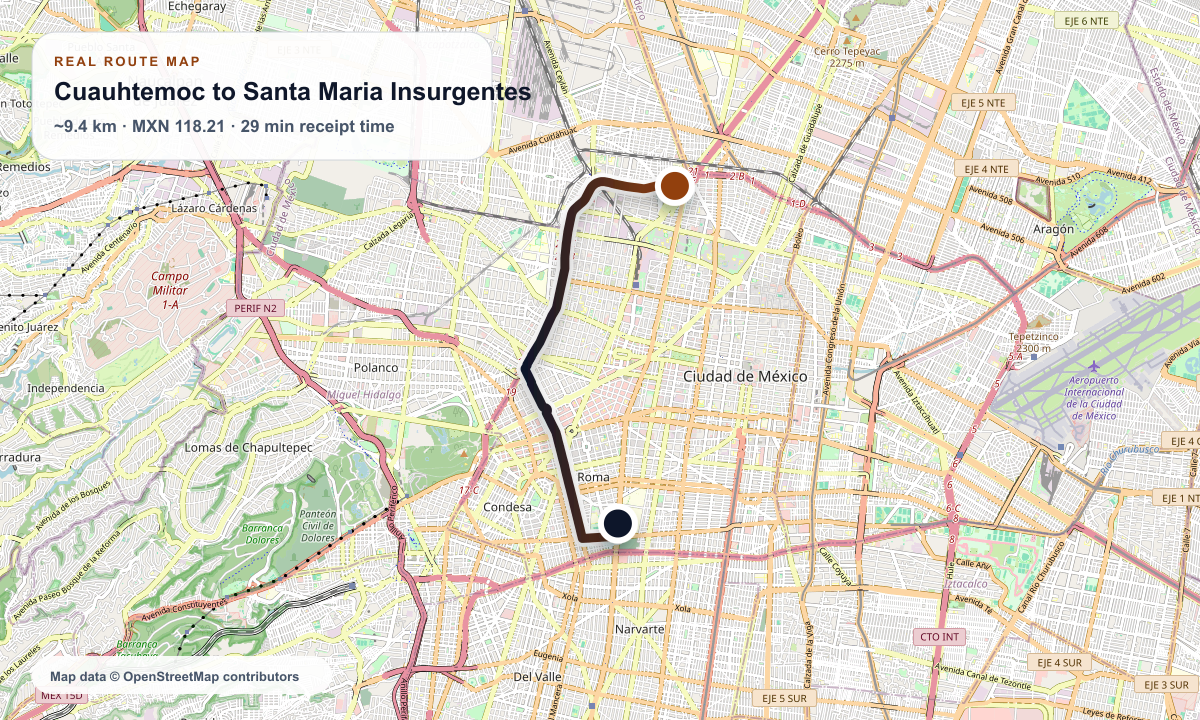
This shows why price alone is not the whole story. Similar route scale, lower fare, longer receipt time.
Use these as a sanity check, not a promise. Wait & Save can trade a longer pickup wait for a lower Uber fare, and a 10 km route can be cheap at 3:46 AM but annoying at 6:20 PM in rain. Also: the Narvarte example is an airport departure toward AICM, not proof that airport arrivals are simple.
How to read the receipt examples
| Methodology point | What we used | What it means | What it does not prove |
|---|---|---|---|
| App product | Uber Wait & Save completed receipts | Real paid rides, not simulated quotes | Not a standard UberX or Didi side-by-side test |
| Dates | March 9 and March 18, 2026 | Recent enough to calibrate 2026 CDMX planning | Not a June 2026 live price check |
| Distance | Approximate mapped driving distance from route context | Good enough to compare route scale | Not Uber’s internal fare distance |
| Fare | Final receipt fare before tip | Useful proof that sub-MXN 150 central rides happen | Not a guaranteed rate card |
| Airport context | Narvarte-area departure toward AICM Terminal 1 | Relevant for StayWork guests leaving for the airport | Not proof that AICM arrival pickup is easy |
For month-long stays, the cheapest ride is still the one you do not need every day. Compare monthly apartments in Mexico City and the cost of living in Mexico City for digital nomads before you build a routine around rideshare.
Price comparison: practical CDMX routes
These are practical fare ranges we use for guest planning, not live app quotes. Prices move with rain, traffic, cancellations, events, and driver supply. Check both apps before booking.
| Route | Common traveler or work use | Uber estimate | Didi estimate | Practical choice | Caveat |
|---|---|---|---|---|---|
| Roma Norte to Condesa | Cafe, dinner, park, coworking | MXN 40-70 | MXN 35-55 | Didi unless Uber is already much closer | Often walkable; a ride may not save time |
| Roma Norte to Polanco | Office meeting, museum, client dinner | MXN 60-110 | MXN 50-90 | Didi for normal timing, Uber for meetings | Reforma and Polanco traffic can erase savings |
| Narvarte to Roma Norte or Condesa | Social route, cafes, dinner, coworking | MXN 65-120 | MXN 55-100 | Compare both | Short rides can still get stuck by block-level traffic |
| Narvarte to AICM Terminal 1 | Airport departure from a residential base | MXN 125-300 | MXN 110-260 | Compare both, then choose cleaner timing | Departure is easier than airport arrival pickup |
| Roma Norte to AICM Terminal 1 | Airport departure from central stay | MXN 130-300 | MXN 110-260 | Compare both | Do not use this row for AICM arrivals |
| Roma or Narvarte to Santa Fe | Corporate meeting or Uber Shuttle relevance | MXN 180-380 | MXN 160-330 | Check both plus Shuttle | Rush hour can make time worse than price |
| Roma or Narvarte to Estadio Azteca | World Cup or match-day route | MXN 180-360 | MXN 150-320 | Check apps, Metro, and event routing | Match days can break normal pricing |
| Roma Norte to Teotihuacan | Long day trip | MXN 500-700 | MXN 450-650 | Compare with private driver pricing | App return logistics can be awkward |
The repeated pattern is simple: Didi often saves money, especially on normal central rides. Uber is the backup when Didi gets thin: after midnight, outside central neighborhoods, when you cannot wait through a second cancellation, or when an Uber-specific product fits better.
Availability and wait times
Uber usually feels stronger when availability matters more than price. Didi is good in central neighborhoods, but the difference shows up late at night, outside tourist zones, during weather, and around events.
Our default workflow:
- Open Didi first for normal daytime rides.
- If Didi shows an 8+ minute pickup, no drivers, or a weird route, open Uber.
- If both are expensive and the Metro route is direct, use the Metro.
- If the ride is for an airport departure or work meeting, choose the app with the cleaner pickup time, not the cheapest fare.
| Timing or condition | What usually changes | Best first move | Better than both apps when… | Remote-worker caveat |
|---|---|---|---|---|
| Weekdays 7-10 AM | Pickup may be fine, but ride time stretches | Check Uber and Didi before committing | Metro route is direct | Do not schedule a call within 30 minutes of arrival |
| Weekdays 4-8 PM | Surge and traffic both rise | Open Didi first, then compare Uber | You can wait it out at a cafe | Move after dinner if timing is flexible |
| Rainy afternoon or evening | Prices jump and cancellations become more likely | Compare both apps immediately | You are near Metro or Metrobus | Keep calls from the apartment during rainy season |
| Friday or Saturday late night | Demand spikes after dinner and bars | Uber first if outside central areas | You are already near a safe transit route | Price matters less than safe pickup |
| Major event or World Cup route | Road closures and demand distort prices | Check app route before booking | Shuttle, Metro, or walking is predictable | Avoid housing that depends on daily cross-city rides |
| Direct Metro corridor | Rideshare may be slower and much pricier | Use Metro unless luggage or safety changes the plan | Almost always for rush-hour cross-town trips | Good apartment location reduces daily rideshare dependence |
Safety: what actually matters
Both apps are easier to control than improvising a street taxi at night because you can verify the driver, plate, route, trip history, support channel, and emergency tools before the car moves.
That does not mean you switch off your brain.
Uber Mexico lists safety tools such as PIN verification, trip tracking, RideCheck, phone anonymization, audio or video recording features where available, support, and insurance coverage. Didi Mexico lists driver verification, trip details before pickup, trusted contacts, facial recognition checks, emergency tools, audio recording, trip monitoring, and 24/7 support. Those features are useful only if you use them.
| Safety decision | Uber | Didi | What you should do | Caveat |
|---|---|---|---|---|
| Confirming the right car | Plate, model, driver profile | Plate, model, driver profile | Match all three before entering | Do not rely on car color alone |
| Preventing wrong-car pickups | PIN verification where available | Strong trip verification and security tools | Use the PIN when shown and confirm the driver | Airport areas can be confusing |
| Sharing the trip | Trip sharing available | Trusted contacts and trip sharing tools | Share late-night or airport rides with a contact | Sharing does not replace route awareness |
| Handling route concerns | GPS route and support trail | GPS route and support trail | Watch the route if something feels off | Some detours are normal in CDMX traffic |
| Women-focused option | Uber Mujeres is rolling out in CDMX | Didi Mujer is mainly driver-side in Mexico sources | Female riders should check Uber availability first | Availability depends on driver supply |
| Street taxis and negotiation apps | Not applicable | Not applicable | Use Uber or Didi instead | Visitors should avoid fare negotiation when tired |
We do not send guests to InDrive. The savings are not worth explaining driver vetting, fare negotiation, and vehicle uncertainty to a tired visitor.
Payment: cash vs card
Add a card to both apps before landing. Then keep small bills anyway.
The old travel-blog answer is too clean: “card is safer” or “cash is cheaper.” In CDMX, the practical answer depends on the ride.
| Rider situation | Best setup | App to try first | What can go wrong | Practical fix |
|---|---|---|---|---|
| International card only | Add card to both apps before landing | Didi for price, Uber for backup | Card authorization or driver cancellation | Keep a second card loaded |
| Short local ride | Card plus small bills | Didi | Driver may prefer cash for low fares | Carry MXN 50 and MXN 100 notes |
| Large bills only | Card | Uber or Didi | Driver may not break MXN 500 | Break bills before relying on cash |
| Work trip needing receipts | Card | Uber | Cash receipt trail is weaker | Use card for reimbursable rides |
| Couple or group splitting costs | Card | Didi | Cash split gets messy | One person pays by app, others settle separately |
| Good service or luggage help | Card ride plus cash tip | Either | In-app tips may feel less direct | Tip MXN 10-20 in cash |
Uber and Didi both support card and cash in Mexico. Didi still tends to feel less awkward with cash, but for work trips and receipts, card is cleaner. If you are booking a longer stay, use a monthly apartment checklist before arrival so payment, Wi-Fi, workspace, and transport questions are settled before the first ride.
The AICM airport situation, June 2026
This is the section that changes fastest.
As of June 2, 2026, airport app pickups at AICM remain legally and operationally sensitive. AICM’s May 2026 updates describe work on boarding and drop-off bays for transport services without federal-zone access, and enforcement around terminal passenger boarding areas remains active. The official airport taxi page lists authorized providers such as TaxiRide, Yellow Cab, Sitio 300, Nueva Imagen, Confort Unlimited, CASADEY, Porto Taxi, Prho Taxi, T&M, PSTA, and Aerotaxi.
Uber says it has legal protection from sanctions based only on using the Uber app at airports. Mexican transport authorities have also said app companies do not have authorization to operate inside airport polygons. Both things can be true at the same time, which is exactly why arrivals feel confusing.
So here is the host advice:
| Arrival situation | Best first option | Use Uber or Didi? | Why | Caveat |
|---|---|---|---|---|
| Solo traveler, daylight, carry-on only | Compare Uber and Didi | Yes, if outside pickup is easy | Cheapest practical option if you can walk | Enforcement and pickup points can change |
| Checked luggage or tired arrival | Authorized airport taxi | Usually no | Less walking and less confusion | Costs much more than many app rides |
| First time in CDMX | Authorized airport taxi or pre-arranged transfer | Only if comfortable navigating pickup | Reduces arrival stress | Worth the premium after a long flight |
| Late-night arrival | Authorized taxi or private transfer | Maybe, but be cautious | Clearer pickup path | Do not wander far from terminal with luggage |
| Business traveler needing a simple receipt | Authorized taxi, Uber, or pre-booked transfer | Yes, if pickup is legal and clear | Easier reimbursement trail | Confirm receipt requirements before expensing |
| Budget traveler with light luggage | Didi, then Uber | Yes | Usually lowest cost | Confirm driver, plate, and exact pickup point before walking |
For terminal-specific walking decisions, use our dedicated AICM airport transportation guide. It is the page we update when the airport situation changes.
If the arrival ride is already making you anxious, step back and solve the bigger problem: choose where to stay in Mexico City for monthly furnished stays so your daily route is not a negotiation every morning.
2026 product changes worth knowing
Uber is not just “the expensive app” in 2026. Its product breadth is getting more relevant in Mexico City.
Uber Mujeres: Announced in Mexico in May 2026 and rolling out in CDMX, Monterrey, Guadalajara, Los Cabos, and Cancun. For female riders, this can matter more than a small fare difference.
Uber Shuttle: Available on selected Mexico City routes, especially around Santa Fe. Uber’s Mexico page describes fixed seats, booking ahead, QR or PIN boarding, and cash-free trips. Useful, yes. But do not build a World Cup transport plan around a shuttle until the route actually matches your apartment, stadium, and call schedule.
Uber Taxi / MX Taxi: Uber and concessioned taxi groups announced a Mexico City alliance in March 2026. This may matter around airport and event logistics, but check the actual option shown in your app before relying on it.
World Cup tools: Uber has announced mobility planning for World Cup cities, including airport and event-zone coordination. That does not mean every ride will be easy. It means the app experience may change around stadium days, fan zones, and high-tourism routes.
Didi’s strongest argument is still simple: price, everyday central coverage, and a Mexico-specific safety stack. For many normal rides, that is enough.
Other apps worth knowing about
Cabify: Still useful as a backup in CDMX. Smaller footprint, often a little more expensive, sometimes calmer.
Authorized airport taxis: Expensive compared with many app rides, but clearer at arrivals when AICM enforcement is active.
Mi Taxi / city taxi options: City taxi tools exist, but they are not the default recommendation we give first-time visitors.
InDrive: We do not recommend it for guests. Locals may use it. Visitors who are tired, carrying luggage, or new to CDMX should not start with a negotiation-based ride.
Tips we give every guest
1. Always verify before getting in. Check the plate, driver name, and car model. This takes five seconds.
2. Sit in the back seat. It is safer and culturally normal in Mexico.
3. Do not let rush hour surprise you. Weekdays 7-10 AM and 4-8 PM can turn a simple ride into a calendar problem.
4. Rain changes everything. During rainy season, May through October, afternoon and evening prices can jump quickly. The Metro does not care about rain.
5. Use the Metro when the route is obvious. At MXN 5 per ride, it often beats every app during rush hour.
6. Avoid random street taxis at night. Use Uber, Didi, authorized airport taxis, or a pre-arranged transfer.
7. Tip in cash when service is good. MXN 10-20 is enough for a normal ride; more if the driver helped with luggage or waited through a difficult pickup.
Practical verdict: which app should you open first?
| Situation | Open first | Backup move | Why this is the better first check | Caveat |
|---|---|---|---|---|
| Normal daytime ride in Roma, Condesa, Juarez, Narvarte, or Polanco | Didi | Uber if pickup is 8+ minutes | Often lower fare with similar central coverage | Recheck both during rain or events |
| Time-sensitive work meeting | Uber | Didi only if Uber is surging hard | Larger product depth and availability matter more than small savings | Leave a traffic buffer |
| Short cafe, dinner, or grocery ride | Didi | Walk or Metro if route is simple | Low fares make savings meaningful on repeat rides | Some short rides are barely worth waiting for |
| Late-night ride after midnight | Uber | Didi if Uber surge is unreasonable | Better backup when central supply gets thin | Verify plate, driver, and route before entering |
| Female rider prioritizing driver match | Uber | Didi if Uber Mujeres is unavailable | Uber Mujeres is now rolling out in CDMX | Availability depends on driver supply |
| Airport departure from your apartment | Compare both | Authorized taxi or transfer if timing is tight | Fare gap can be large, but punctuality matters | Airport arrivals are a separate problem |
| Airport arrival with luggage | Authorized taxi or transfer | App only if pickup is clear | Less terminal stress | More expensive |
| Cross-town trip during rush hour | Neither by default | Metro if direct | Metro can beat both price and time | Use rideshare for luggage, safety, or complex routes |
Bottom line: download both. Open Didi first for everyday price checks. Switch to Uber when timing, availability, airport uncertainty, Uber Mujeres, Shuttle, Reserve, or event logistics matter. Use the Metro when traffic is absurd. Do not take random street taxis at night.
When the apartment location matters more than the app, compare Mexico City neighborhoods for monthly stays, browse monthly apartments in Mexico City, and use Book Direct to confirm dates, Wi-Fi, workspace, and route questions before you pay.
Sources checked on June 2, 2026
- AICM updates on transport boarding/drop-off bays and taxi-provider negotiations: May 13, 2026 AICM bulletin
- AICM authorized taxi providers: official AICM taxi page
- Uber Mujeres Mexico launch: Uber Mexico Newsroom, May 5, 2026
- Uber Shuttle Mexico: Uber Shuttle Mexico page
- Didi passenger safety tools in Mexico: Didi Mexico passenger safety page
- Uber Wait & Save rider help: Uber Help
- Uber Mexico World Cup mobility updates: Uber Mexico Newsroom, April 27, 2026